

An honest answer to the question “Is there a definitive cure for facial paralysis?” — and what can really be done today when paralysis does not recover
First, let us ask the right question
The first phrase that everyone whose facial paralysis has still not recovered after months types into the internet is: “a definitive cure for facial paralysis.”
The hope behind this search is understandable. So let us give the answer clearly, right from the start:
There is no “definitive cure” that returns the paralysed nerve to its former state and makes the face exactly as it was before. Bringing a dead nerve back to life, or restoring a muscle that has wasted away, is not possible with today’s medicine. Do not trust any centre or any method that promises this.
But the rest of the answer is far more hopeful:
Permanent facial paralysis has permanent solutions. Facial reanimation surgery (bringing movement back to the face) can restore the smile by bringing a new nerve supply or a new muscle to the paralysed side. It can protect the eye from permanent damage. It can make the face sit symmetrically at rest. It can correct leaking while eating, distortion while speaking and drooling.
These are not “make-do” solutions; they are operations that genuinely change quality of life and give lasting results. It is just that the goal is not “getting your old face back”, but “gaining a face that works.”
This guide explains those options, which one is used in which situation and — most critically — why time matters so much.
Important note: This content is for general information. Which method suits you can only be determined after examination, nerve-muscle tests and imaging, by a team experienced in this field.
1. The three questions that decide everything
When a facial reanimation specialist first sees you, they are really trying to understand three things. The answers to these three questions draw almost the entire treatment map.
Question 1: How long has the paralysis been present?
This is the single most decisive factor. The reason: muscles cannot survive without nerves.
A muscle that receives no stimulation from its nerve begins to waste away. The points where the nerve connects to the muscle — the motor end plates — deteriorate irreversibly over time. This deterioration is usually complete at around 18–24 months. Beyond that point, even if you bring a new nerve to the muscle, the muscle will not respond, because the “socket” that would receive the signal no longer exists.
This splits the treatment logic in two:
-
If the muscle is still alive → bringing a new nerve to it is enough (nerve operations)
-
If the muscle has died → a new muscle has to be brought in from elsewhere (muscle transfer)
Question 2: Is the paralysis complete or partial?
Is there no movement at all in the face, or is there some flicker, however weak? Partial movement shows that some of the muscles are still working, and this may mean results can be achieved with much less extensive procedures.
Question 3: Where does the problem originate?
Is the nerve damaged at the brainstem, inside the bony canal, or cut within the face? Was the nerve sacrificed during tumour surgery? Does the nerve have a healthy “upper end”? This determines which technique is possible.
The tests used: detailed examination and grading (House-Brackmann, Sunnybrook), EMG (the most important test, showing whether the muscles are alive), MRI or CT, and movement analysis with photographs and video.
2. Why does facial paralysis become permanent?
The great majority of facial paralysis cases — especially Bell’s palsy — recover on their own. The group that becomes permanent is a minority and is usually linked to specific causes. Seeing your own situation in this list makes it easier to understand which options are on the table.
After tumour surgery. One of the most common causes of permanent paralysis. In operations for acoustic neuroma (vestibular schwannoma), skull base tumours or parotid (salivary gland below the ear) cancer, the facial nerve may not be preservable; sometimes it is deliberately sacrificed so that the tumour can be removed completely. This group is the most favourable for reanimation surgery — because exactly when and where the nerve was cut is known, and repair can be planned in the same operation or immediately afterwards. The most important point here, however, is not to wait a long time. Very good results are possible with early intervention.
Severe Ramsay Hunt syndrome. Facial paralysis due to shingles of the ear runs a markedly worse course than Bell’s palsy. In patients who develop complete paralysis, the rate of full recovery is low.
Trauma. Temporal bone fractures, facial injuries, gunshot wounds, stab and cut injuries. Very good results are possible with early intervention.
Chronic ear disease. Untreated middle ear infection and especially cholesteatoma can erode the bony canal through which the nerve runs.
Congenital conditions. In Möbius syndrome and similar rare conditions, the facial nerve or muscles have never developed.
Birth trauma. Rarely, an injury during birth may be permanent.
Severe or late-treated Bell’s palsy. A small percentage of Bell’s palsy cases do not fully recover. Not starting cortisone within the first 72 hours increases this risk — which is why we emphasised the time window in our first article.
Systemic diseases. Sarcoidosis, advanced Lyme disease, some autoimmune conditions.
Why does it matter? Because the path changes with the cause. For example, in a patient whose nerve is known to have been cut surgically, a nerve graft can be placed in the same session, and the result is much better. In a patient who has had radiotherapy for cancer, the tissues are more difficult and planning differs. In patients whose cause is unknown, the true reason for the permanence must first be investigated — in particular, a hidden tumour must always be ruled out in slowly progressive paralysis.
3. The time map: the most critical section
The table below is the most important part of this article. If there is one thing a person living with facial paralysis needs to know, this is it.
| Duration | State of the muscles | Priority option |
|---|---|---|
| 0–3 months | Alive | Recovery is awaited; the eye is protected, rehabilitation |
| 3–12 months | Alive but beginning to waste | The most productive period for nerve operations — graft, masseter or hypoglossal transfer |
| 12–18 months | Critical threshold | Nerve surgery can still be tried but success falls; the window is wider in children |
| Over 18–24 months | Motor end plates have deteriorated | Muscle transfer (smile surgery) and static methods |
| Years later | No muscle | Muscle transfer, static sling, eye surgery — a great deal can still be done |
Two conclusions follow from this:
First: if your paralysis is less than a year old and there is no improvement, waiting is costly. “Let’s wait a bit longer, maybe it will come back” is the riskiest advice in this period. Getting an assessment does not mean agreeing to surgery — but it keeps the door open.
Second: if you have had paralysis for years, you are not too late. Only the path changes: instead of nerve surgery, muscle transfer and static methods come into play. A smile can be restored even to a patient with a 10-year-old paralysis.
4. The treatment map: which method in which situation?
The table below is a simplified version of the decision logic used in clinics. You can find your own situation and see which sections to read — but remember that the final decision is made after examination.
| Your situation | Leading options |
|---|---|
| The nerve was cut during surgery, the ends are available | Direct repair or nerve graft — in the same session |
| Paralysis less than 12 months old, muscles alive on EMG | Masseter transfer, hypoglossal transfer, cross-facial graft or a combination |
| Paralysis more than 2 years old, muscles wasted | Gracilis muscle transfer (smile surgery) |
| Does not want or cannot tolerate surgery | Static sling, brow lift, eye procedures |
| The eye does not close | Upper lid weight, lower lid suspension (canthopexy) — a priority in every scenario |
| There is movement but it is wrong (synkinesis) | Botox + neuromuscular rehabilitation; selective nerve cutting or muscle removal in selected cases |
| Congenital paralysis (Möbius, etc.) | Muscle transfer; if both sides, two muscle transfers in one or two sessions |
| Child patient | Wider window; nerve surgery can be tried up to 18 months |
An important fact: these options are not rivals. In most patients, treatment is staged — for example, the eye is protected first, then a muscle transfer is done for the smile, and finally a static procedure or Botox is added to fine-tune symmetry. A plan that promises to solve everything in a single operation is usually not a realistic plan.
5. Nerve operations: while the muscle is alive
The aim is simple: to bring a signal from somewhere else to the paralysed facial muscles.
5.1. Direct repair and nerve grafting
If the nerve was cut recently (for example during tumour surgery) and both ends can be found, the ends are joined directly. If there is a gap between them, a sensory nerve taken from elsewhere in the body (usually the sural nerve in the leg) is placed as a bridge.
The best results come from repair in the same operation or in the first months. The result usually provides a symmetrical resting position and reasonable voluntary movement; however, some synkinesis (involuntary co-movement) is almost unavoidable.
5.2. Masseter (chewing nerve) transfer
This is the most widely used nerve transfer today, and its logic is elegant: a branch of the nerve that drives the chewing muscle is cut and connected directly to the smile branch of the facial nerve.
Why is it so popular?
-
It is fast. The first movement appears at around 5 months on average — the fastest of the nerve operations
-
It is strong. The number of nerve fibres it carries is far greater than that of the alternatives. This means a strong and reliable contraction
-
No graft is needed in between — the nerve is close enough to be connected directly
-
Little loss at the donor site — chewing function is not noticeably affected
Disadvantage: the smile gained is initially not spontaneous. The patient first learns to smile by “clenching the teeth”. With rehabilitation, the brain can automate this connection over time, and in many patients the smile becomes increasingly natural — but this does not happen to the same degree in every patient. Some patients are bothered by their face moving when they eat.
5.3. Hypoglossal (tongue nerve) transfer
Part of the nerve that moves the tongue is redirected to the facial nerve. It is a reliable method that has been used for many years.
In older techniques, the nerve was sacrificed completely, causing wasting of the tongue and problems with speech and swallowing. In modern techniques only part of the nerve is used, and these problems have largely disappeared. It is successful at restoring facial tone and providing resting symmetry.
It is usually preferred when masseter transfer is not suitable, or together with it.
5.4. Cross-facial nerve grafting (CFNG)
The most elegant idea, but the method that demands the most patience.
The logic: one of the surplus branches of the facial nerve on the healthy side of the face is cut and carried to the paralysed side through a long nerve graft (again taken from the leg) passed beneath the upper lip. In this way, the paralysed side is fed by the same command as the healthy side.
Advantage: this is the only method that can provide a genuinely spontaneous smile. When you laugh at a joke, both sides move together.
Disadvantages — honestly:
-
It is slow. It takes 6–8 months for nerve fibres to cross the 20 cm graft. Add the recovery process, and the timescale is longer still
-
It is lossy. At each connection point, only 20–50% of the fibres can cross
-
For this reason, results can be unpredictable when it is used on its own, so it is combined with other nerves. Success falls with age
-
It is usually a two-stage process
5.5. The combination approach (the “babysitter” technique)
The modern trend is to combine the strengths of the two methods:
The speed and strength of the masseter nerve + the naturalness of the cross-facial graft.
In practice, the masseter transfer quickly keeps the muscles alive (it “babysits” them), while fibres from the cross-facial graft slowly arrive and over time take over spontaneous movement. This combined approach is one of the most favoured strategies of recent years.
6. Muscle transfer: “smile surgery”
If the paralysis has been present for a long time and the facial muscles can no longer be revived, the solution is clear: bring in a new muscle from elsewhere.
How is it done?
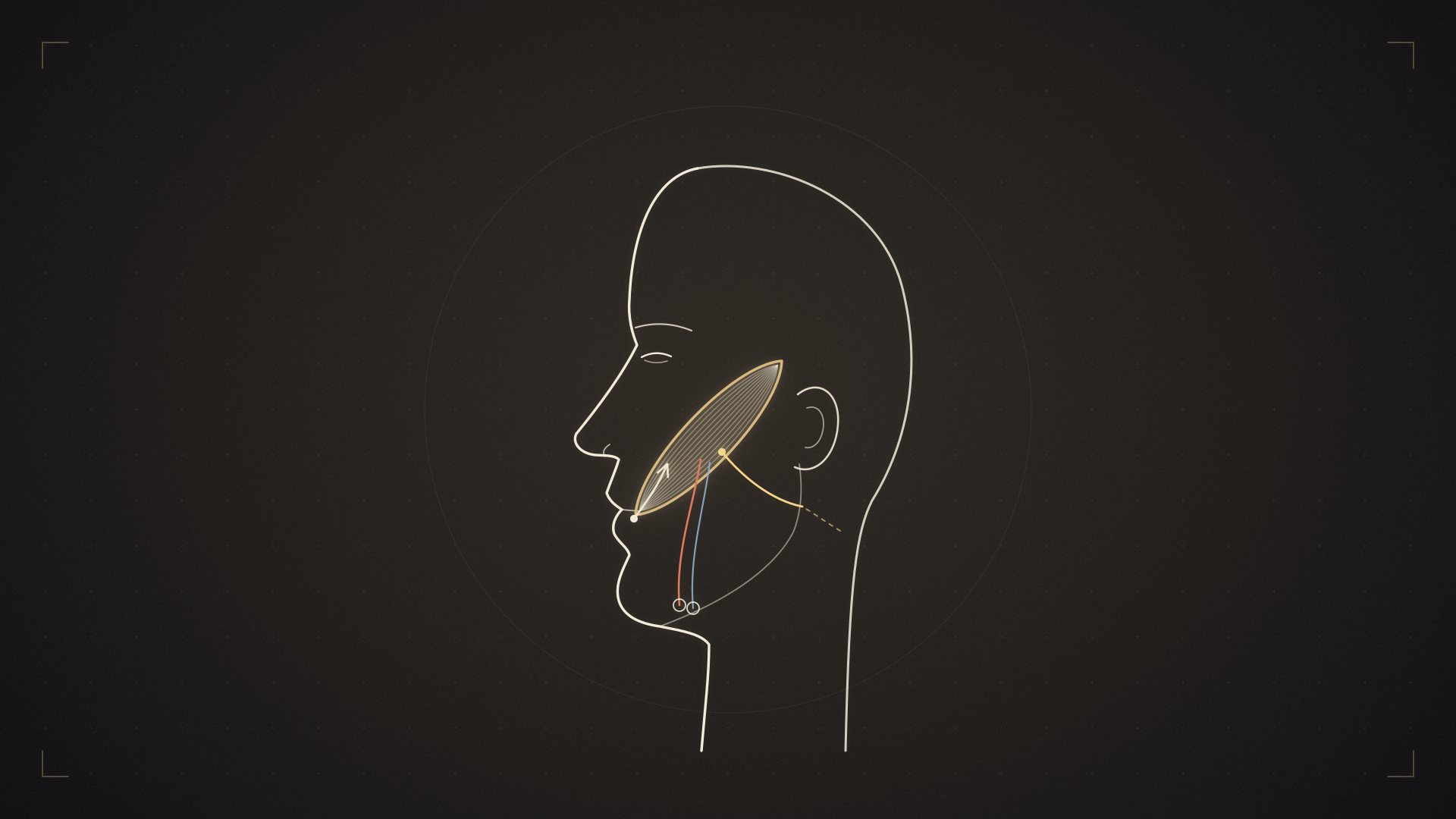
Usually part of the gracilis muscle on the inner side of the thigh is used. A small portion of this muscle is taken with its own artery, vein and nerve and moved to the face; its vessels are connected to vessels in the face, and its nerve to the chosen donor nerve, using microsurgical technique. One end of the muscle is fixed to the corner of the mouth, the other to the cheekbone.
This is a major operation requiring microsurgery and usually takes 6–8 hours.
Which nerve will drive the muscle?
There are three options, and the choice depends on the patient’s priority:
| Donor nerve | Strength | Weakness |
|---|---|---|
| Masseter nerve | Strong and reliable contraction, fast result | The smile is voluntary at first — “smiling by biting” |
| Cross-facial graft | Spontaneous, natural smile | Weaker, slower, may be unpredictable |
| Dual innervation | Combines the advantages of both | More complex; the masseter input may dominate |
In recent years, dual innervation has become increasingly common. Multi-vector designs are also used: the muscle can be directed not in a single direction but in several, towards the corner of the mouth, the upper lip and the lower eyelid.
How does the process work?
-
Surgery — the muscle is transferred
-
First 3 months — healing; no movement yet. There is temporary fullness in the face
-
Months 3–9 — the first contractions appear. This moment is the turning point of the process for patients
-
Months 9–18 — strength increases, and movement is brought under control with rehabilitation
-
Months 18–24 — the final result; small refinements are made if needed
How much movement can be expected?
Surgeons measure the result by how many millimetres the corner of the mouth moves. In general, around 1 cm is considered a good result; less than 4 mm is considered inadequate.
But more important than the numbers is this: for the great majority of patients, the real gain is being able to smile in photographs, to smile at their child, and to feel that their face belongs to them.
7. Static methods: balance, not movement
For some patients, movement is not the goal. Because of older age, other illnesses, inability to tolerate a long operation or the patient’s own preference, smaller procedures may be chosen. Static methods do not restore movement, but they make the face sit symmetrically at rest and correct functional problems.
Fascial sling (static suspension): the corner of the mouth is suspended upwards using a strong strip of connective tissue taken from the thigh (fascia lata). The drooping corner of the mouth is corrected, and food leakage and drooling are reduced. The effect is immediate.
For detailed information on Static Sling Surgery, which does not create movement but aims to improve facial symmetry at rest and support the corner of the mouth, see our dedicated guide.
Brow lift: a drooping eyebrow can obstruct the upper field of vision. A one-sided brow lift both opens the visual field and corrects symmetry.
Facelift (one-sided): repositioning of sagging cheek tissue. Over the age of 50, it can be done on both sides before nerve and muscle transfer.
Nasal ala suspension: collapse of the side of the nose on the paralysed side makes breathing through that side difficult. A suspension procedure opens the nasal passage — a gain most patients do not expect but are very pleased with once they notice it.
Lower lip balancing: asymmetry of the lower lip creates a difference in tooth show when smiling; in selected patients it can be balanced with procedures on the opposite side.
8. The eye: always the first priority
Even though the most visible problem in facial paralysis is in the face, permanent damage can occur in the eye — and it is completely preventable. That is why the eye always comes first in the order of treatment — even before smile surgery.
If the eyelid does not close fully, the cornea is constantly exposed, dries out, gets scratched and becomes infected. This can end in permanent loss of vision.
The methods used:
Upper lid weight (gold). The most commonly used method. A thin metal plate is placed inside the lid; it closes the lid with the help of gravity. Simple, reversible and effective. Possible problems: the implant being visible, shifting, rarely extruding, mild astigmatism.
Lower lid tightening (lateral tarsal strip). The loose, outward-turned lower lid is tightened and seated back against the eyeball. It markedly reduces watering and dryness.
Tarsorrhaphy. Stitching part of the lids together. Usually for temporary, emergency protection; it can be opened once permanent solutions come into play.
Brow lift prevents a drooping eyebrow from weighing on the eye.
And in every case, regardless of surgery: artificial tears by day, eye gel and lid taping at night, glasses outdoors. If the eye becomes red or painful, or vision blurs, see an eye doctor without delay.
9. Synkinesis and overactivity: the “too much movement” problem
Permanent facial paralysis also has an opposite: the nerve has healed, but healed wrongly.
During recovery, nerve fibres connect to the wrong muscles. The result: the eye closes when smiling, the corner of the mouth twitches when blinking, the eye waters when eating (“crocodile tears”), the face is constantly tight, and at rest the paralysed side looks even more “pulled” than the healthy side.
For these patients, treatment is completely different — the aim is not to add movement but to silence excess and wrong movement.
Botox (botulinum toxin): the mainstay of treatment for this group. It is injected in small doses into overactive muscles. The effect lasts 3–6 months and is repeated. It is sometimes also applied to the healthy side to achieve balance. Unlike cosmetic Botox, it is started with stepwise doses, and an individual dose is worked out for each person.
Neuromuscular retraining: a special physiotherapy programme, using a mirror and biofeedback, that teaches you to suppress wrong contractions and isolate the correct movement. It gives the best result when combined with Botox — Botox turns down the noise, and rehabilitation teaches the correct movement.
Selective nerve cutting (neurectomy) and muscle cutting (myectomy): in resistant cases, the nerve branches going to the overactive muscle are cut selectively, or part of the muscle is removed. For overactive muscles, muscle cutting is the easier and more reliable method. Nerve cutting, however, may be more advantageous for larger muscle groups that are not easy to cut.
10. Rehabilitation: half of the operation
Skipping this section would be the biggest mistake of this article.
In facial reanimation surgery, the operation is half the job. The other half is the brain learning the new connection.
An example: a smile muscle driven by the masseter nerve is, for the brain, initially linked to the “chew” command. The patient learns to clench the teeth to smile. With months of regular practice, the brain separates this command; in many patients the smile becomes increasingly involuntary and natural. This does not happen on its own — it happens with a therapist, in front of a mirror, through regular practice. In other words, the therapist and the patient’s own work are as important in this process as the surgeon who performs the operation.
The scope of rehabilitation: movement awareness training, isolated movement exercises, biofeedback, symmetry exercises, work on speech and eating function, and synkinesis control.
The period before surgery matters too: maintaining joint and tissue flexibility, shaping the patient’s expectations and clarifying goals.
11. What to expect? A realistic framework
Managing expectations is the strongest determinant of satisfaction with these operations.
Realistic goals:
-
A more symmetrical, more natural face at rest
-
A voluntary, visible smile that can be photographed
-
Protection of the eye and the ability to close it
-
Improved eating, drinking and speaking; less leakage
-
Less social anxiety and the return of self-confidence
Unrealistic goals:
-
A face identical to the one before the paralysis
-
The full return of all facial expressions (forehead wrinkling usually does not return)
-
Everything solved with a single operation — in most patients the process is staged
-
Synkinesis eliminated entirely
The process is long. The first movement is seen 5–9 months after nerve surgery and 3–9 months after muscle transfer; the final result takes 18–24 months. This is a journey that requires patience and regular follow-up.
12. Daily life and the psychological dimension
Living with permanent facial paralysis is more than a medical condition. The face is at the centre of our identity and communication; this is why paralysis cannot be compared with a similar loss anywhere else in the body.
Common experiences: avoiding photographs, not speaking in meetings, turning off the camera in video calls, shying away from meeting new people, consciously suppressing laughter. A significant proportion of patients experience symptoms of social anxiety and depression; this directly affects adherence to treatment and satisfaction after surgery.
These are not “exaggerations” or “cosmetic concerns”. Research shows that the impact of facial paralysis on quality of life is comparable to that of many serious chronic diseases. Psychological support should be planned as part of the process — not put off until after surgery.
Practical tips:
-
Eating and drinking: small bites, chewing on the healthy side, sitting upright. A straw may be difficult; wide-mouthed cups make things easier.
-
Oral care: food collects in the immobile cheek; the risk of tooth decay increases. Pay attention to brushing and rinsing.
-
Speech: slowing down markedly improves intelligibility. Some patients benefit from speech therapy.
-
Eye: glasses in windy and dusty environments, taping at night — whether or not you have surgery.
-
Working life: in professions where appearance matters, temporary adjustments can be discussed. In many countries facial paralysis may be considered a functional disability.
-
Support groups: contact with people who have been through the same process makes a real difference to managing expectations and to motivation.
A note for loved ones: a paralysed face struggles to show emotion — but it does not struggle to feel it. The person in front of you looking expressionless does not mean they are uninterested. This awareness is what the patient needs most.
13. In children and in congenital facial paralysis
The picture is more hopeful in children. The nervous system is more adaptable, and the window for nerve surgery is wider — the limit of about 12 months in adults can extend to 18 months in children.
In congenital facial paralysis (for example Möbius syndrome), the muscles may never have developed; in this case muscle transfer is the primary option. In paralysis on both sides, it is performed on each side in two stages.
Timing: muscle transfer is usually planned at school age, when the child can take part in rehabilitation and social awareness is developing. Early intervention is valuable for the child’s social development.
14. Where should you go?
Facial reanimation is a field in which plastic surgery, ENT, neurology, ophthalmology and physiotherapy work together, and it is performed by a small number of surgeons. Going to the right place is as important as the technique itself.
Questions to ask:
-
What is your experience with these operations? What is your microsurgical experience?
-
What options are there in my case, and why do you recommend this one?
-
Does my EMG show that my muscles are alive?
-
When should I see the first movement? When will the final result come?
-
How many stages will the process involve?
-
Who will run the rehabilitation? Is there a facial rehabilitation therapist you can refer me to?
-
What else do we need to do for my eye?
-
Can I see before-and-after videos of your own patients? (Since movement matters in these operations, photographs alone are not enough.)
Warning signs: approaches that guarantee the result, promise a “definitive cure”, reduce the process to a single operation, or never mention rehabilitation.
15. Frequently asked questions
I have had paralysis for 5 years — am I too late?
Probably yes for nerve surgery, but not for muscle transfer. A smile can be restored even years later. What changes as time passes is the method, not the hope.
Do stem cells or nerve-regenerating treatments work?
Research in this area is ongoing, but today there is not enough evidence to support their routine use in facial paralysis. Postponing proven treatments in search of experimental methods costs time — and in this condition, time translates directly into results.
Acupuncture, electrical stimulation, special devices?
In permanent paralysis, they cannot restore movement without bringing a new nerve to the muscle. There are also data on the potential for harm from electrical stimulation. Discuss them with your team, provided they do not delay surgical assessment.
Will the surgical scars be visible?
In muscle transfer, the incision is usually planned like a facelift incision along the front and back of the ear and fades over time. A long but thin scar may remain at the donor site on the thigh, but it is covered by clothing and leg function is not affected.
Can I have smile surgery and eye surgery at the same time?
Often yes; many surgeons perform eye procedures in the same session as the muscle transfer or shortly afterwards. Your team will decide the order.
Will my chewing be affected after surgery?
In masseter nerve transfer, only one branch of the chewing muscle’s nerve is used; chewing function is not noticeably affected. There are also several other muscles responsible for chewing. In hypoglossal nerve transfer, modern techniques have largely prevented tongue problems.
Will my smile look natural?
Dual innervation and multi-vector designs have brought marked progress in this respect. Even so, the goal is not “perfect symmetry” but “a natural-looking smile that works”.
I smoke — is that a problem?
Yes, a serious one. It increases the risk of vessel blockage in microsurgery and directly threatens the success of the muscle transfer. Most centres require patients to quit.
Both sides of my face are paralysed. Are there options for me too?
Yes. In paralysis on both sides, a cross-facial graft cannot be used (there is no healthy side), so other donor nerves such as the masseter nerve come to the fore. Muscle transfer is usually done in two separate operations, first on one side and then the other. Eye protection is even more critical in paralysis on both sides.
Will my condition get worse if I do not have surgery?
The face itself usually does not get worse in terms of paralysis, but that side sags faster as it ages faster. Over time, muscle shortening, tissue sagging and more obvious synkinesis may appear. The real risk is to the eye: an unprotected eye can suffer permanent damage over the years. And the window for nerve surgery closes — so a decision “not to have surgery” may, a few years later, mean “that option no longer exists”.
Can the paralysis come back after surgery?
The transferred muscle or nerve is not affected by the original disease. However, if the underlying cause persists (for example a tumour recurrence), the situation may change; this is why planning differs for patients under oncological follow-up.
Are these operations covered by insurance?
Reanimation after facial paralysis is reconstructive, not cosmetic, surgery. Coverage varies by insurer and indication; you need to discuss it in advance with the centre and your insurer.
Summary: 8 things to remember
-
There is no “definitive cure” that restores the nerve to its former state — do not trust approaches that promise one.
-
But there are permanent solutions. The smile can be restored, the eye protected and symmetry achieved.
-
Time determines the method. Without a nerve, muscles waste irreversibly in about 18–24 months.
-
The first 12 months are the golden period for nerve surgery — if there is no recovery, do not wait; get an assessment.
-
If 12–24 months have passed, the door does not close — muscle transfer and static methods can be used even years later.
-
The eye always comes first. The most lasting damage happens there, and it is completely preventable.
-
Synkinesis is a separate field of treatment — a problem of too much movement, not too little; it is managed with Botox, rehabilitation and surgery.
-
Rehabilitation is half the operation. The brain takes months to learn the new connection, and it does not happen without practice.
For a personal assessment of your situation, you can request an evaluation appointment; for the physician’s training and experience, see the physician profile.
This content is for general information and does not replace examination, diagnosis or treatment by a physician. If your facial paralysis has not recovered for months, contact a centre experienced in this field to find out which options suit you — getting an assessment does not mean deciding on surgery.
Assoc. Prof. Ahmet Hamdi Sakarya, MD, MSc
Specialist in Plastic, Reconstructive and Aesthetic Surgery
Assoc. Prof. Ahmet Hamdi Sakarya completed a two-year fellowship in reconstructive microsurgery and peripheral nerve surgery at Chang Gung Memorial Hospital in Taiwan, one of the world’s leading high-volume microsurgery centers. His clinical practice focuses on facial paralysis and facial reanimation, brachial plexus and other peripheral nerve injuries, functional muscle transfers, free tissue transfers and facial aesthetic surgery.


